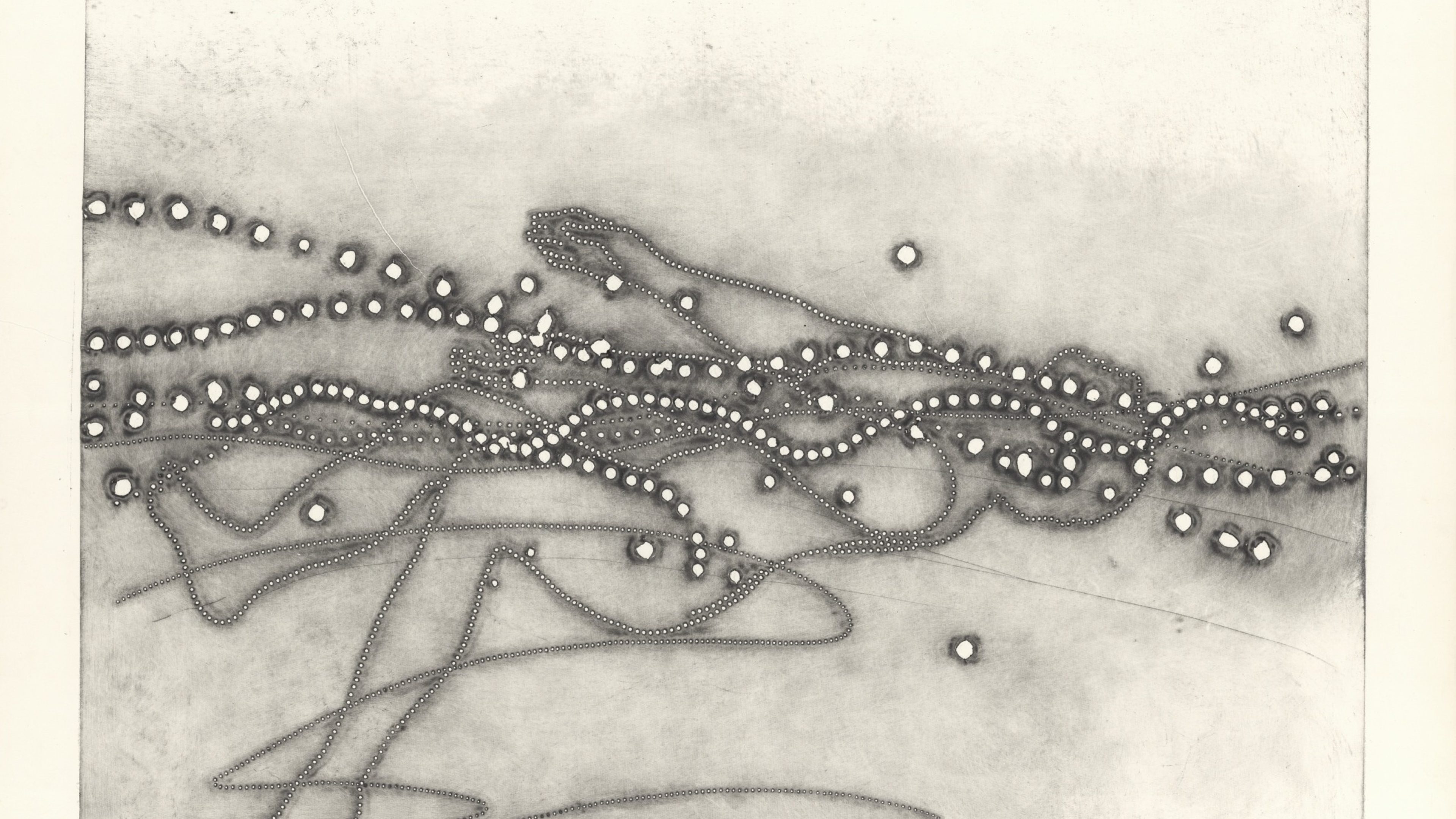
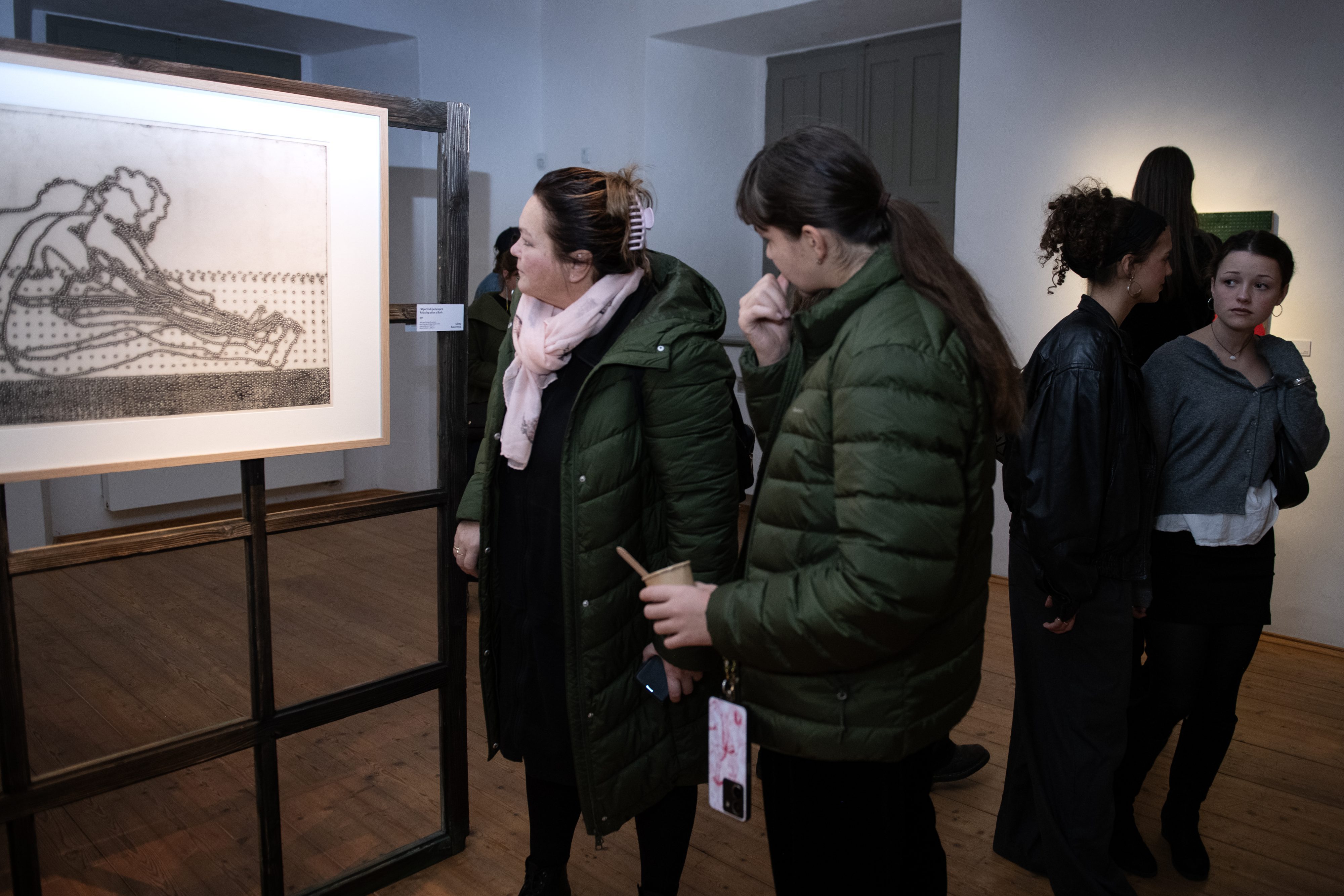
Alena Kučerová (*1935) has been one of the most distinctive artists on the Czech scene since the early 1960s, someone who introduced experimentation and innovative approaches in particular into the graphic arts, and she has done so on a global scale. Since the beginning of her career as an artist, a fundamental building block in her work has been the use of structure and the point. After initially combining drypoint, etching, and perforated printing, in the mid-1960s her main artistic technique became perforations and her works took on new spatial and lighting qualities. She began to exhibit print matrices made of perforated metal as objects in their own right, and in the late 1960s she briefly worked with colour. Although she initially tended towards a constructivist visual vocabulary, in the mid-1960s her main theme became the figure (mostly women) and the landscape, motifs which are associated with a specific experienced situation. With her depictions of people and the landscape, she touches on deeply personal themes and the experience of being in nature. Her work underwent another transformation after 1996, when she had to leave her Prague studio and lost the chance to work with a printing press. She nevertheless continued to experiment with material in the form of assemblages and embroideries in which the landscape and rural settings took on new meaning. The tension between abstraction and representation has remained one of the main characteristics of her work.
The exhibition presents a cross-section of Kučerová’s work that follows her path from the perforated point all the way to the assemblages from her most recent artistic period. It is being held in conjunction with an exhibition of works by Dalibor Chatrný (1925–2012), which focuses on his work with perforated paper and the ‘seeping-through’ process. Like Kučerová, he was an experimenter and an observer of nature. Both artists worked with perforations, light, and the illusion of space. Nevertheless, although their visual language shows certain similarities, they differed in their methods. Dalibor Chatrný’s process was one of exploration, whereas Alena Kučerová saw colour or the perforated point as tools for producing the work’s end effect. Each artist’s original approach and relationship to the landscape guided them towards a deeper understanding of the world.
Alena Kučerová was born on 28 April 1935 in Prague, where she studied at the Academy of Arts, Architecture, and Design, graduating from Antonín Strnadel’s studio in 1959. In 1961–1965 she was a member of the UB 12 art group, with which she exhibited after 1962. She became a member of Umělecká Beseda in 1992. Her first award came in 1965 – honourable mention at the 4th Biennale des Jeunes in Paris. She was a regular participant in international graphics biennials around the world. During Normalisation, she could not show her art at official exhibitions, but she submitted her works to international festivals, at which she won numerous awards. Her first solo exhibition was in 1965 at the Gallery on Charles Square in Prague, which also where she first showed print matrices as standalone objects alongside the prints she made with them. Her art can be found in leading collections at home and abroad.

 English
 Česky
Česky